


Sample Quiz Questions
Making Med School Mildly Hilarious!
Please take a peek at a few of our questions! We hope you find the questions are just what you need to self-assess for your curriculum, with a little dash of fun. You will also note that the explanations don't leave you hanging by telling you the right answer is right because it is correct and the others are wrong because they are incorrect. Yeah, that drives us nuts too! If you like what you see, please sign up for our free trial or head directly to the subscriptions for access to all of the questions!

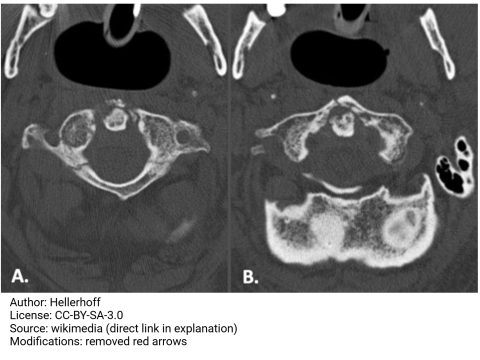
Dr. Ake, a 37-year-old professional rapper, is enjoying his beautiful lagoon-style pool at his Toronto mansion. He makes his pool staff take a short video of him diving straight down into the pool from the shallow end to impress his fans. Gotta do it for the 'gram! Unfortunately, Dr. Ake emerges from the pool with neck pain and dizziness after hitting his head on the bottom. Just in case, Dr. Ake has his personal on-call physician do a full workup. An axial CT series of his cervical region is shown in the accompanying image. What is the most likely diagnosis?
- Hangman's fracture
- Fracture of the dens
- Anterior dislocation of C1
- Jefferson burst fracture
- Bow Hunter syndrome
- Cervical spinal stenosis
Explanation/Answer
Poor Dr. Ake, am I right? If you picked a Jefferson burst fracture, you nailed it. This type of injury is also known as a traumatic spondylolysis of C1. The CT images show fractures of the anterior and posterior arches of C1 (remember, C1 does not have a vertebral body!). The little nubbin articulating with the anterior arch is the dens of C2. The most likely etiology of a Jefferson burst fracture is trauma from above, like diving into a shallow pool, in which impact to the top of the skull (i.e., from hitting the pool bottom) translates through the occipital condyles and splits the atlas apart. Eesh.
Hangman's fracture, Nope. A Hangman's fracture is also known as traumatic spondylolysis of C2. The etiology is typically a hyperextension injury, such as hitting your chin on the steering wheel of your car during a car accident. Dr. Ake suffered a C1 injury, as indicated by the mechanism of injury and the CT scans shown. Good try, though!
Fracture of the dens: You don't even have the right view of the dens to tell if it's fractured. Try a lateral x-ray or sagittal CT. In this case, there is not enough evidence to suggest that Dr. Ake's dens was fractured. His C1 is clearly in shambles, though.
Anterior dislocation of C1: Nah. Anterior dislocation is most likely due to rupture of the transverse ligament of the atlas, holding the anterior arch of the atlas up against the dens. The CT images show the dens nice and snug up against the anterior arch of C1!
Bow Hunter Syndrome is highly unlikely; Bow Hunter Syndrome refers to compression of the vertebral artery due to prolonged or forceful head rotation. Symptoms include dizziness and fainting. Dr. Ake didn't keep his head turned for too long - he made a dumb move and dove headfirst into a shallow pool. While his fractured C1 may result in vertebral artery compression from bone fragments, the vertebral foramina looks pretty clear in the accompanying CT images. Bow Hunter Syndrome really isn't likely here.
Cervical spinal stenosis: I can see where you're going with this - often, vertebral injuries result in motor or sensory deficits due to spinal stenosis. In this case, however, spondylolysis of C1 from a superior impact typically bursts the bone fragments apart, actually making stenosis LESS likely. His spinal cord is most likely fine, assuming his doc gets him stabilized in time.
Wyatt and Darlene manage to have a baby using Wyatt's cousin Ruth as the surrogate. The infant is born with some issues, surprisingly not related to Darlene's advanced age, but rather X-linked. Baby Jacob has had multiple infections since his birth a few months ago. He also suffered from an infected umbilical cord stump. Jacob was diagnosed with Leukocyte adhesion deficiency (LAD). Jacob likely had mutations that affected which of the following processes?
- Formation of the membrane attack complex
- Diapedesis of neutrophils across the vascular endothelium
- Production of reactive oxygen species
- IFN-gamma function
- Phagocytosis
Explanation/Answer
If you picked diapedesis of neutrophils across the vascular endothelium, you ROCK! Also, perhaps Darlene won't put a bullet in you. If you know, you know. There are two types of LAD, but the one described in this case is LAD1. A mutation in the integrin CD18 characterizes LAD1. The LAD1 mutation in CD18 does not allow leukocytes (neutrophils) to bind tightly to the vascular endothelium and migrate across the endothelial cells into the tissue. Those affected by LAD can't generate pus or abscesses since the neutrophils can't get into the tissue. An early sign of LAD is omphalitis, the delayed separation of the umbilical cord stump due to the lack of leukocyte's ability to gain access to the tissue, clear pathogens, and repair the tissue.
Formation of the membrane attack complex leads to complement deficiencies that affect an individual's ability to respond appropriately to Neisseria infections. This deficiency could be in any MAC proteins from C5 to C9.
Production of reactive oxygen species results in another x-linked disease called Chronic granulomatous disease (CGD). CGD results from mutations in NADPH oxidase. These mutations result in a lack of superoxide and hydroxyl radicals formed in the phagolysosome. The lack of superoxide radicals leads to an increase in the frequency and severity of infections with catalase-positive bacteria and fungi.
IFN-γ function can be hindered due to a mutation in the IFN-γ receptor or an inability to make IFN-γ. The outcome is usually increased susceptibility to tuberculosis and other facultative intracellular pathogens.
Phagocytosis is a possibility if any deficiencies prevent them from doing their jobs, which could be CGD, LAD, etc. However, as far as the process of engulfing pathogens by phagocytes is concerned, I am not aware of any specific mutations.


A genetics lab exercise designed to show that we are all unique involves students rubbing the inside of their cheeks with cotton swabs. The DNA collected is subjected to a protocol that involves the use of an enzyme, producing the following image from lab group A (each lane is a different student's sample). What technique was used here?
- Dot blot analysis with allele-specific oligonucleotide probes
- Microarray analysis
- Mutational analysis by PCR
- RT-PCR analysis
- Variable number of tandem repeats analysis
Explanation/Answer
If you said a Variable number of tandem repeats analysis, right on! The DNA was subject to restriction enzyme treatment, with the specific restriction endonuclease chosen to take advantage of a region of variable number of tandem repeats in the genome. Genomic tandem repeats vary from person to person, with people who are more closely related having patterns that look more similar than those who are not closely related at all. This technique may also be used in crime scene analysis.
Dot blot analysis with allele-specific oligonucleotide probes, Nope. They are not looking at a specific gene, so this technique is out.
Microarray analysis: No way! Microarray analysis is pretty pricey and used for comparing the expression of a bunch of genes at once between 2 samples (e.g., normal vs. cancerous tissue biopsy).
Mutational analysis by PCR, Nope. Mutation analysis by PCR is useful in determining which specific mutation in a gene an individual has, but this lab didn't involve looking at a specific gene.
RT-PCR analysis, Not it. RT-PCR is a way to indirectly examine mRNA expression from a sample, which is not what this lab exercise was designed to do.